About these guidelines
Mizzou’s brand, communications and marketing materials should always be authentic and credible. How these materials are created must also be secure to protect Mizzou’s reputation, data and intellectual property.
These guidelines establish boundaries and use cases for using generative AI tools when creating internal and external communications and marketing materials at Mizzou.
What is generative AI?
Generative AI models use large amounts of data to iterate text, images, music, videos, code and more based on inputs or prompts.
While generative AI is powerful and evolving rapidly, remember that it does not think. Generative AI looks for statistically probable content related to the request, inquiry or input. It is important and necessary to always review and revise all generative AI content.
Generative AI
- Is prompt based.
- Relies on statistical probability.
- Generates something new with every prompt.
What is non-generative AI?
Non-generative machine learning AI is trained on data for a very specific and narrow task and it should not be confused with generative AI.
An example of a non-generative AI tool that is common in design programs is “Remove/Select background.” This tool is trained to identify a specific element and either select it or remove it for the user. It does not insert data or generate a new iteration of the material.
Non-generative AI
- Is not prompt-based.
- Uses data to perform a specific and narrow task.
- Does not create something new.
Navigating these guidelines
Jump to:
Data security and Mizzou’s intellectual property
Why do we need to consider data security when using generative AI?
- Free generative AI tools keep the prompts, data and other information you provide in return for use of the tool. Any information provided to these models and the results they return become public and become available for the generative AI model to use and iterate on.
- AI-generated content is not eligible for copyright protection and may inadvertently contain copyrighted material. In the event of litigation, all information provided to the generative AI could be collected and used against the person who input the information.
- The Data Classification System helps you identify the right AI tools for each use case. Learn more about DoIT Artificial Intelligence Compliance Policies and Guidelines.
- Always log in to university-approved tools using your UM System email to ensure you access the protected version of the tool.
Generative AI tools
The following generative AI tools are approved for data up to Data Classified Level (DCL) 3, which covers the data in most marketing and communication materials:
- Google Gemini Pro
- Microsoft M365 Copilot (Premium)
- Microsoft M365 Copilot (Basic)
- Free for all Mizzou employees.
- ChatGPT Education
- Additional tools
Guidelines for using generative AI
At Mizzou, we prioritize original, human-created work in all our communications and marketing materials. Generative AI may be used as a tool to help strengthen, not compromise, our work when creating marketing and communication materials. It may be incorporated into creative brainstorming, iteration, research, data analysis, content summaries, editing and saving time with routine tasks.
Generative AI users must:
- Verify generative AI content is accurate and unbiased.
- Verify the generative AI content does not include copyrighted or trademarked material owned by others.
- Ensure that all Mizzou guidelines around the use and implementation of generative AI in marketing and communication materials are followed.
Questions about generative AI
- Accessing and/or using generative AI tools, contact: aisupport@missouri.edu
- Use of generative AI for communications and marketing materials, contact: brand@missouri.edu
Jump to:
Mizzou trademarks and campus landmarks
Generative AI may not be used to create, replicate, alter, mimic or stylize any of Mizzou’s trademarks (including service marks, names and indicators), landmarks, buildings or people (leadership, employees, students and their families).
This includes, but is not limited to:
- Trademarks
- Stacked MU
- Athletic Tiger Head
- Spirit Tiger Head
- Truman the Tiger
(and custom Truman illustrations)
- Signatures and seals
- Mizzou signature
- Unit signatures
- UM Seal
- Brand assets
- Brand patterns and icons
- Brand fonts
- Mizzou Athletic font
- Landmarks
- The Columns
- Jesse Hall
- Memorial Union
- Francis Quadrangle
- Athletic facilities

Signatures:
Do not create unit signatures or other logos.

Athletic Tiger Head:
Do not generate or stylize the Athletic Tiger Head.

Truman the Tiger:
Do not generate Truman the Tiger in scenes.
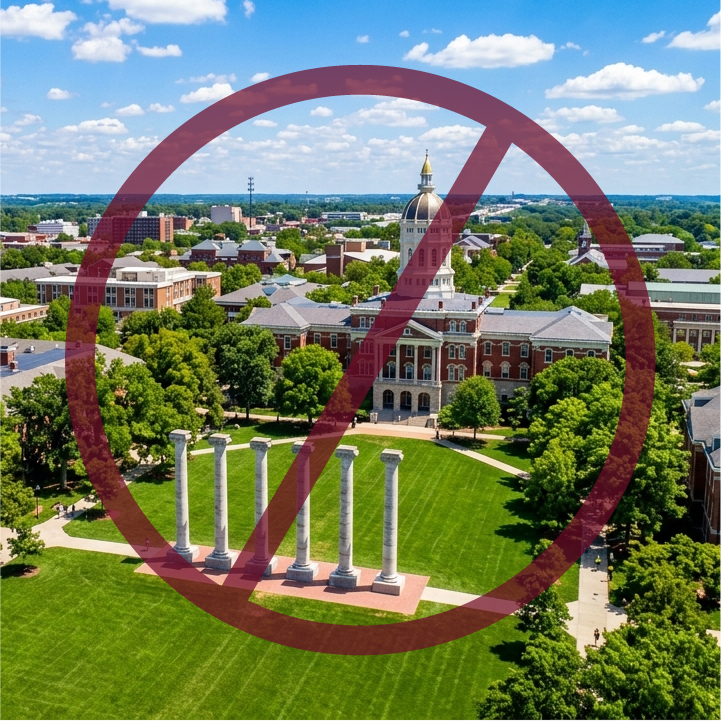
Landmarks:
Do not generate Mizzou landmarks in imagery.
Branding and graphic design
To protect Mizzou’s brand and communicate authentically with our audiences the use of generative AI in graphic design is restricted. Please review each section to understand where generative AI can best fit into your graphic design workflow.
The Mizzou Brand
The Mizzou brand may not be recreated, modified, altered or fed into generative AI tools. This includes, but is not limited to:
- Brand fonts
- Brand graphics
- Arrows
- Containers
- Footers
- Icon
- Illustrations
- Lower Thirds
- Patterns
- Signatures
- Mizzou signatures
- University of Missouri signatures
- Unit signatures
- Trademarks
Use assets in the Mizzou brand toolkits. For additional assistance, contact brand@missouri.edu.
Graphic design
Generative AI tools may not be used to generate final marketing materials for internal or external use. This includes, but is not limited to:
- Flyers
- Handouts
- Presentations
- Social media graphics
- LED screen graphics
- Brochures
- Invitations
- Business Cards
- Letterhead and e-letterhead
- Envelopes
- Name badges/tags
- Animations
Prioritize using Mizzou brand templates or working with your area’s marketing team. For additional assistance, contact brand@missouri.edu.
Stock photography
- Filter stock searches: When searching for stock photos, turn off or exclude “Generative AI” in the search parameters.
- Prioritize real campus photography: To protect Mizzou’s brand authenticity, use real photos. Mizzou’s Digital Asset Platform hosts high-quality photography of campus and student life that are available for use in marketing materials.
Non-generative AI tools
Non-generative and utility-focused AI tools in standard design applications are permitted within guidelines.
- Content-aware fill: Extend natural elements like sky or grass in a real photo to fit different sized materials and aspect ratios.
- Object removal: Clean up minor distracting elements from photography. Refer to the Mizzou photography and editing guidelines for details.
- Creative and project briefs: May use AI tools to outline or draft project briefs for internal review and use.
- Visual brainstorming: May use AI tools to explore visual concepts during brainstorming.
- Generative upscale: May use AI image enhancement tools to increase the resolution or pixel count of university-owned photos to meet production requirements.
- Mood boards: May use AI tools to create mood boards to internally pitch a design concept. Do not input third-party IP.
- Data visualization: May use AI tools to assist in creating charts and graphs. It is mandatory that all data is manually verified for accuracy.
- Abstract/conceptual imagery: Do not generate or publish abstract and/or conceptual imagery for use in materials.
- Typography and fonts: Do not use AI tools to generate text, typography or custom lettering in any brand font. Mizzou’s brand fonts are legally protected intellectual property and may not be uploaded into or rendered by AI tools.
- Photorealistic imagery: Do not generate images that represent reality or could be mistaken as authentic Mizzou campus scenes, students or employees. Real photos are the priority in all marketing materials.
- Art styles: Do not prompt AI tools to produce imagery “in the style of” specific artists (e.g., “in the style of Bob Ross” or “Monet”).
- Mizzou brand style: Do not prompt AI tools to produce imagery “in the style of Mizzou branding” or upload brand assets.
- AI stock photography: Do not use AI-generated stock photography. Real photos should be used to uphold the Mizzou brand and authentic communication with our audiences and prevent copyright infringement.
- Layout design: Do not upload Mizzou brand graphics, trademarks or other intellectual property to AI tools and prompt AI tools to generate page layouts or designs.

Photography, audio and video
Photography and video are an important part of our communications and must remain authentic and credible.
Photography and photo editing
These guidelines are specific to the use of generative AI tools in photography and photo editing. For full guidelines on photography and editing requirements review Mizzou’s photography and video editing guidelines.
Generative AI may not be used to create photos that will be used in internal or external communications and marketing materials at Mizzou.
AI tools may be used to help with tasks during photoshoot brainstorming and photo editing, but the results must be reviewed and edited by a human for accuracy.
Stock photography
- Filter stock searches: When searching for stock photos, turn off or exclude “Generative AI” in the search parameters.
- Prioritize real campus photography: To protect Mizzou’s brand authenticity, use real photos. Mizzou’s Digital Asset Platform hosts high-quality photography of campus and student life that are available for use in marketing materials.
Non-generative AI tools
Non-generative and utility-focused AI tools in standard design applications are permitted within guidelines.
- Content-aware fill: Extend natural elements like sky or grass in a real photo to fit different sized materials and aspect ratios.
- Object removal: Clean up minor distracting elements from photography. Refer to the Mizzou photography and editing guidelines for details.
- Shot lists: May create a photoshoot shot list.
- Storyboarding: May storyboard a photoshoot that will be physically shot by a human. No AI-generated images from the storyboard may be used in the final material.
- Generative upscale: May use AI tools to increase the number of pixels in a photo to achieve industry standards for production.
- Generative remove*: May use AI tools in design programs to remove approved content from photos.
- Alternate text: May use AI tools to suggest alternate text for photos. Alt text must be reviewed for accuracy.
*Before using any generative remove or fill tools, review Mizzou’s photography and video editing guidelines.
- Abstract/conceptual imagery: Do not generate abstract/conceptual imagery.
- AI stock photography: Do not use AI-generated stock photography. Real photos should be used to uphold the Mizzou brand and authentic communication with our audiences and prevent copyright infringement.
- Photorealistic Imagery: Do not create images that look photorealistic but are not real. Our photos should be authentic and real.
- Portraits: Do not generate headshots or portraits of people.
- Original Intent: Do not modify photos or videos in ways that alter the original intent.
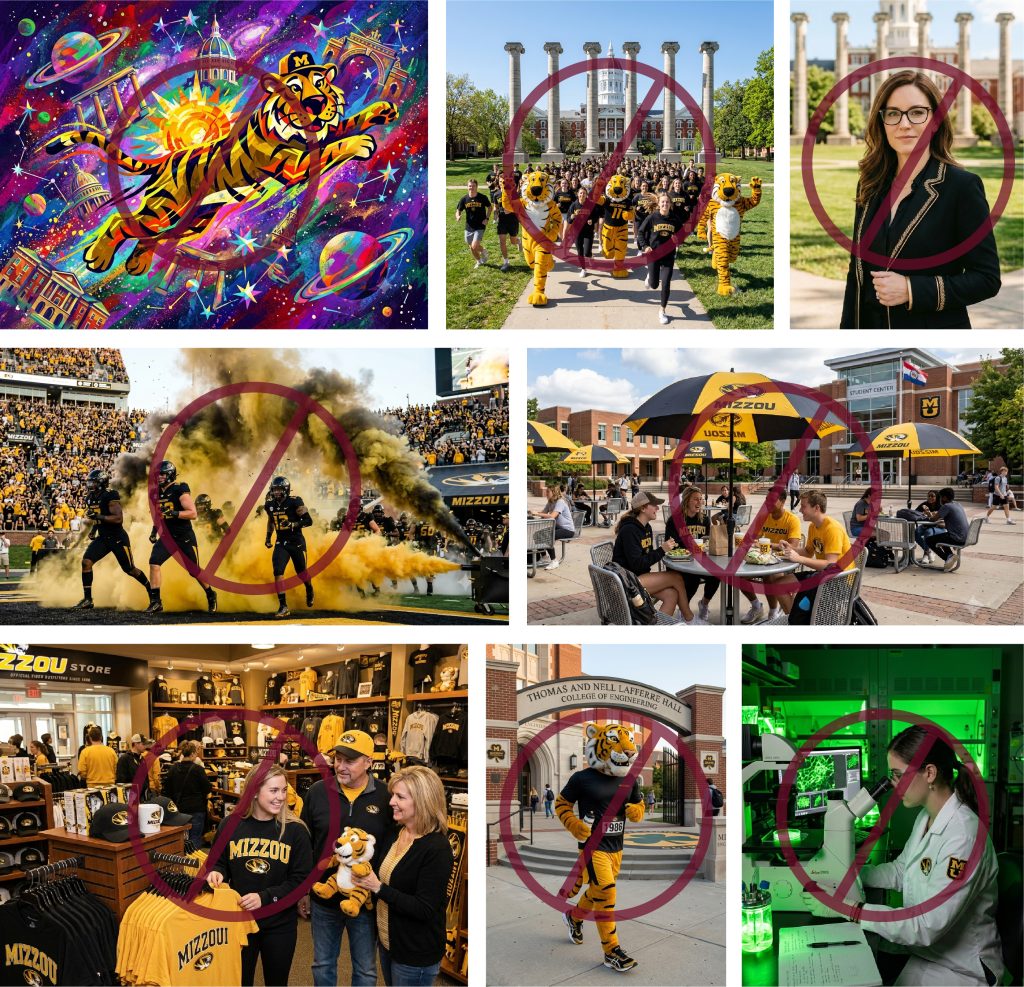
- Mizzou Traditions: Do not create or use AI-generated images/video of Mizzou traditions.
- People, Places and Things: Do not create or use AI-generated images/video of Truman the Tiger, Mizzou students, faculty/staff, athletes or administrators.
- Campus Buildings and Landmarks: Do not create or use AI-generated video of university landmarks and buildings such as the Columns, Jesse Hall, Memorial Union, or other campus or athletic buildings.
Audio and video
Generative AI may not be used to generate audio or video that will be used in marketing materials and communications at Mizzou.
AI tools may be used to help with tasks during video brainstorming and from pre-production to post-production, but the results must be reviewed and edited by a human for accuracy.
These guidelines are specific to the use of generative AI tools in photography and photo editing. For full guidelines on photography and editing requirements review Mizzou’s photography and video editing guidelines.
Stock videography
- Filter stock searches: When searching for stock video, it is recommended to turn off or exclude “Generative AI” in the search parameters.
- Prioritize real campus videography: To protect Mizzou’s brand authenticity, use real videos. Mizzou’s Digital Asset Platform hosts high-quality video clips of campus and student life that are available for use in marketing materials.
Stock music
- Be aware of music source: It is recommended to turn off or exclude “Generative AI” in the search parameters.
- Music license: Make sure to only include music that you have the rights to use.
- Accessible narration: Standard synthetic narration for screen accessibility is permitted.
- Captions: May create text captions from audio. Captions must be reviewed for accuracy.
- Scripts: May draft video scripts. These scripts must be reviewed and edited by a human.
- Shot lists: May create a video shot list.
- Storyboarding: May storyboard a video that will be physically shot or filmed by a human.
- Video descriptions: May create video descriptions for social media platforms like YouTube.
- Video-editing: May use AI tools in editing software that mimic traditional video-editing tools.
- Stock video: Do not use AI-generated stock video. Real videos should be used to uphold the Mizzou brand and authentic communication with our audiences and prevent copyright infringement.
- Audio: Do not use AI tools to generate, clone or simulate the voice of a real person. Including, but is not limited to, quotes, testimonials or statements from faculty, administrators or students.
- Standard synthetic narration for screen accessibility is permitted.
- Editing: Do not publish AI-generated materials as finished deliverables.
- Accessibility: Do not rely exclusively on AI-generated accessibility features without human review.
- Mizzou traditions: Do not create or use AI-generated video of Mizzou traditions.
- People, places and things: Do not create or use AI-generated video of Truman the Tiger, Mizzou students, faculty/staff, athletes or administrators.
- Campus buildings and landmarks: Do not create or use AI-generated video of university landmarks and buildings such as the Columns, Jesse Hall, Memorial Union, or other campus or athletic buildings.
Social media
Social media is a powerful tool that connects users with friends, brands, interests and influencers. These tools are used across Mizzou to promote a variety of priorities.
Authenticity is a key user expectation on social media. Communicators must balance authenticity against efficiency when leveraging AI tools in the social media space.
- Brainstorming: May generate ideas for social posts and campaigns.
- Analysis: May analyze audience trends and behaviors.
- Iteration: May refine content for different audiences.
- Post Captions: May generate ideas for captions.
- Copy editing: May use to help with editing, word choices and tone to align with the Mizzou brand.
- Accessibility: May generate alt-text, captions and transcripts. Must be reviewed for accuracy.
- Graphic Design: May be used in accordance with the generative AI graphic design guidelines.
- Video (including Reels/IG Stories): May be used in accordance with the generative AI video guidelines.
- Unedited AI-generated content: Do not use unedited AI-generated content.
- Always review for accuracy, including alt-text, captions and transcripts.
- Fabricated information: Do not use fabricated information.
- Generative AI can fabricate quotes, statistics and academic citations. Always fact check content before publication.
- Generative AI can fabricate quotes, statistics and academic citations. Always fact check content before publication.
Strategy, planning and productivity
Generative AI may be used to assist in administrative tasks, project management and workflows when used securely. However, protecting university data remains a top priority.
Do not input confidential, protected or sensitive information into generative AI tools without first verifying the AI tool meets the Data Classification System requirements. This includes, but is not limited to strategic documents, personnel information, embargoed content, unpublished research unless available online, proprietary data and trademarks.
- Accessibility and plain language: May use AI tools to translate complex academic content into accessible language, check reading levels, and review documents for appropriate headings/tags for screen readers.
- Brainstorming: May generate meeting agendas, campaign themes and event concepts.
- Outlines: May develop or review content or communication plan outlines.
- Timelines and plans: May create editorial calendars, communication plans or project timelines.
- Meeting and note summarization: May record, transcribe and summarize meetings and notes to generate action items.
- Process automation and coding: May write basic scripts or formulas (e.g., Excel, Google Sheets, Adobe Illustrator) or create automation workflows to save time on routine tasks.
- Data analysis: May analyze and reformat data into tables, summaries or lists for quick review.
- SEO and metadata optimization: May generate descriptions, page titles or alt text for images on a web page. Must be reviewed for accuracy.
- Processing sensitive data: Do not upload restricted or prohibited data into AI tools.
- Unverified research: Never use AI-provided research that you have not verified.
- Automated communication: Do not use AI tools to generate and send un-edited communications.
- Credentials and passwords: Do not include passwords or personal credentials in prompts.
Writing
To ensure authentic Mizzou communications, copyright protection and avoid typical AI copy, it is recommended that you write the first draft before utilizing generative AI tools.
Use the resources available under “Brand Voice” on the Mizzou brand website, including the Mizzou personality archetypes to get started.
- Brainstorming: May explore new angles, headlines and story ideas.
- Research: May gather background information and sources about a specific topic. You must verify all research is accurate.
- Interview questions: May prepare questions to ask someone about a specific topic.
- Tone: Refine human-written copy to different Mizzou brand archetypes.
- AP Style check: May prompt an AP Style check. AI tools frequently hallucinate rules and lack understanding of Mizzou-specific style requirements. Always review the Mizzou Editorial Style Guide.
- Copy editing: May check grammar, spelling and punctuation. Always do a final review to ensure AI does not add any additional content.
- Iteration: May generate iteration options for specific audiences or media forms. All iterations must be reviewed and edited by a human.
- Distilling information: May use AI tools to help distill complex information for different media and audiences.
- Fabricated quotes or testimonials: Do not publish quotes or testimonials generated by AI tools without editorial review and approval from the quoted individual.
- Complete drafts: Do not prompt AI to “write a story” or draft an article or news release without providing a human-created outline or initial draft.
- Unverified information: Always fact check AI-provided information. Do not cite quotations, research, statistics, titles or other important information without verifying the primary source.
- Confidential/embargoed text: Do not input unreleased research, personal data or confidential university information into external AI tools or tools where you are signed in with a personal account. Review the Data Classification System to help you identify the right AI tools to use for each use case.